

Beginner
Learn the vocabulary, use Git and HTTP clients, and reproduce a small local request before opening a Mule runtime.
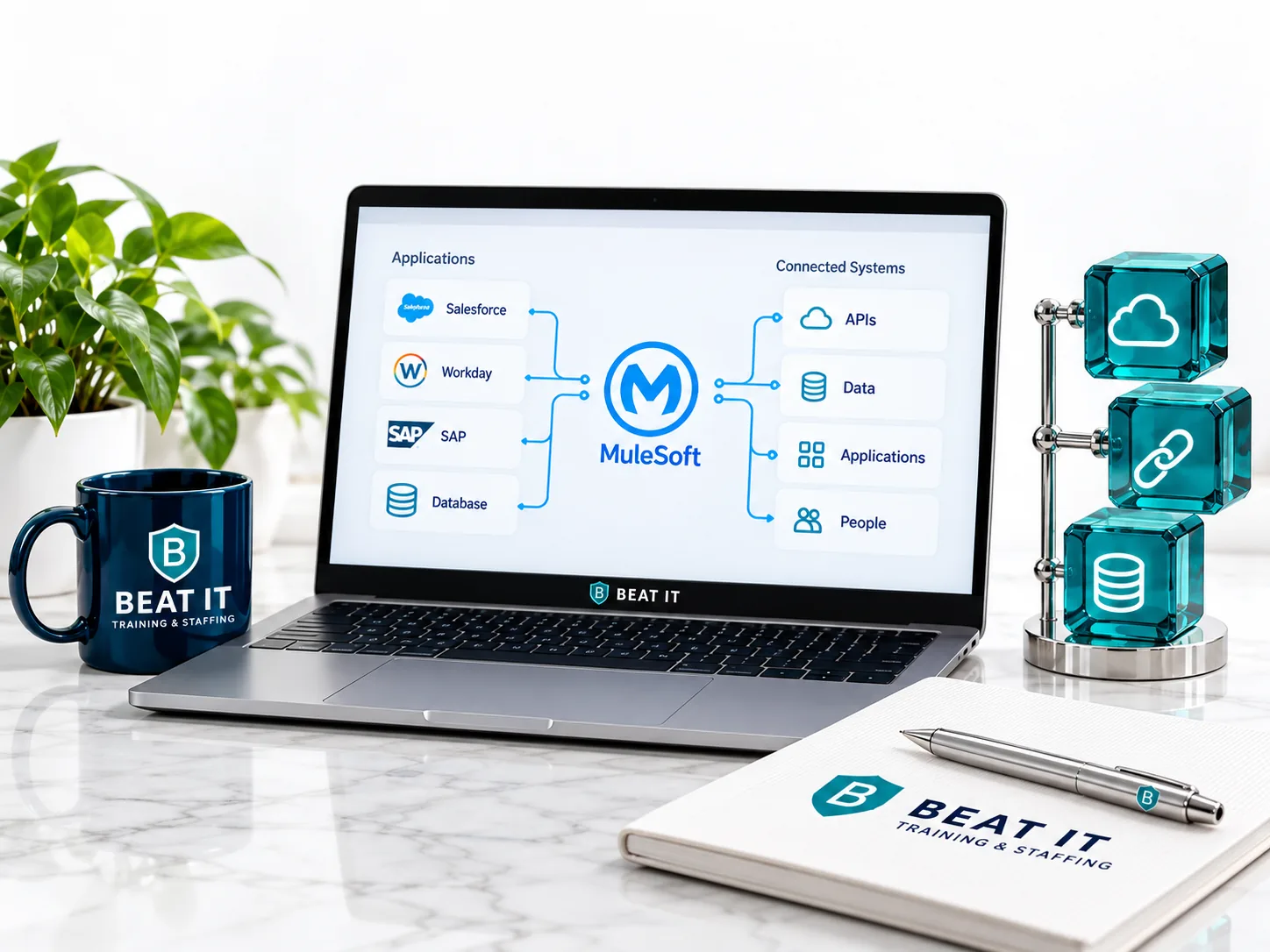
Connect systems. Deliver real integrations.
Video · Reading · AI Tutor · Resources · Labs · Real Job PracticeDownload the MuleSoft practical lab pack (.zip) · Reading and labs are available for review. Videos are not yet recorded. Practical capstone review is separate from knowledge checks.
Please wait while we check your signed-in account.
 BEAT IT TRAINING & STAFFING
An evidence timeline locating the ERP dependency timeout and stating what the logs do and do not prove.
Loading course details…
BEAT IT TRAINING & STAFFINGStart from zero. Build. Deliver.
One Developer bundle covering Level 1 implementation and Level 2 production-ready practices and integrations. Git, Postman and beginner foundations are free.
FREE CAREER PATH PREVIEW
Get a feel for the work. See what you’ll learn. Take your next step.
One Developer bundle covering Level 1 implementation and Level 2 production-ready practices and integrations. Git, Postman and beginner foundations are free.
Where to begin
Begin at the first phase if you are new. Experienced developers can review the early material and use it to identify gaps. The same Store case connects the foundations, core implementation and advanced delivery practice.
Learn the vocabulary, use Git and HTTP clients, and reproduce a small local request before opening a Mule runtime.
Build the core contract, event, flow, connector and error-handling skills, then explain a working implementation.
Deepen reliability, security, automated tests, delivery and operational reasoning, supported by a reviewable portfolio.
L1 and L2 are BEAT IT learning-stage labels. This roadmap is not a claim of official exam alignment, vendor certification, exam eligibility or a guaranteed result. BEAT IT completion certificates and any external certification are separate.
Your roadmap
Every phase adds knowledge, practice, and a portfolio result you can explain during an interview. Select an available course below to open its Video Lessons and Reading Lessons tabs.
Free foundation courses cover files, networks, HTTP, JSON, safe access, Postman / REST Client, Git and team habits. No bundle purchase, previous development or certification is assumed.
Learn the core contract and integration concepts before implementation: HTTP methods, RAML, resources, validation, errors and API-led boundaries.
Build and debug Mule applications with explicit event state, basic DataWeave mapping, connector configuration and error behavior. Level 2 revisits these foundations with production-focused failure, reliability and operational requirements. Separate paper and local-mock exercises from actual authorized runtime evidence.
Apply the Developer 1 foundation to production-focused integrations: reusable DataWeave mappings, validation, synchronous and asynchronous communication, orchestration, persistence/caching, batch, duplicate handling, retry limits and recovery evidence. Production-ready is the learning focus, not a claim that unexecuted runtime work is already verified.
Apply security and MUnit, activate a child application from a managed parent POM, and follow a reviewed Git-to-Jenkins release. Distinguish GitHub / Azure Repos source control, optional Azure Artifacts packages, Exchange publication and CloudHub 2 deployment.
Follow workstation setup, GitHub or Azure Repos, parent / child Maven projects, MUnit, Jenkins, Exchange and CloudHub 2. Live execution requires your own authorized environment.
Compare Azure Repos source hosting with Azure Artifacts Maven packages. Keep the CloudHub 2 Exchange prerequisite explicit.
Use the existing synthetic flows, tests, POMs, client requests and guarded scripts; preserve their verification limits.
Bring the beginner, L1 and L2 practice together through implementation tickets, debugging, code review, support and a defended delivery portfolio. Claim only the environments and checks actually exercised.
Reference and practice
Practice MCP tools, Agentforce and Agent Fabric design, identity boundaries, approvals, RAG, evaluation and recovery. Includes a printable workbook and provider-free Python simulator.
Review the bundle scope, free Git/Postman foundations, Salesforce reference courses and the recorded Mimeo coverage mapping.
Work through reusable modules, nested enrichment, reconciled totals and safe projection with fourteen input cases.
Practice validation, outbound HTTP, dependency errors and replay boundaries with a tested local inventory backend and Mule examples.
Technology toolkit